
Every capability, and what it authorizes
From detecting a contract change to authorizing it, enforcing that authority, and proving it afterwards.
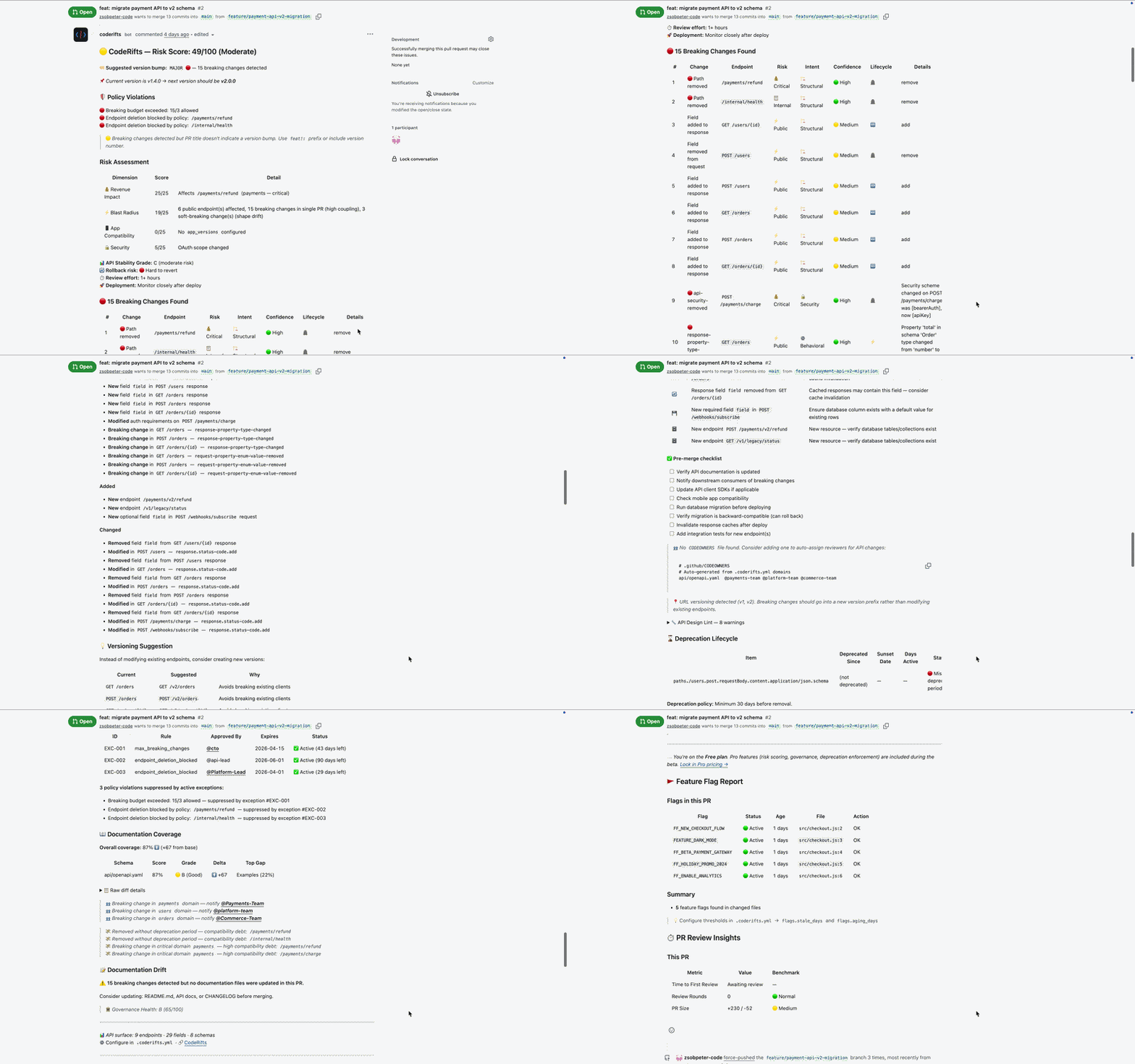
Breaking Change Detection
Core diff engine for OpenAPI 3.0 and 3.1 schemas.
Detects endpoint removals, required field additions, response type changes, enum restrictions, auth changes, parameter modifications, and more.
Auto-Discovery
Automatically finds OpenAPI spec files in your repo.
No configuration needed. CodeRifts scans your repository for .yaml, .yml, and .json files matching OpenAPI patterns.
Semver Suggestion
Recommends MAJOR/MINOR/PATCH based on change severity.
Reads your current version from the spec and suggests the correct next version based on the breaking changes detected.
Breaking Changes Table
Structured table of every breaking change with details.
Each breaking change gets its own row with endpoint, risk level, action type, and a link to the specific diff.
Lifecycle Labels
Docs on requestTags each change: new-endpoint, field-removed, deprecated, etc.
Every change in the breaking changes table gets a lifecycle icon showing whether it's new, modified, deprecated, or removed.
REST in Peace: a dedicated memorial section for removed endpoints.
Commit Consistency Check
Docs on requestValidates PR title matches the suggested version bump.
Warns when breaking changes are detected but the PR title doesn't include a version bump indicator like feat!:.
Web UI, CLI & REST API
Three ways to use CodeRifts: browser, terminal, or API.
Try in the browser with no signup, run locally via CLI, or integrate into any CI/CD pipeline via the REST API.
4D Risk Score
Docs on requestComposite 0–100 score across severity, surface, auth, and stability.
Each PR gets a single risk number combining breaking change severity, affected surface area, authentication impact, and historical stability. Color-coded gauge included.
Confidence Score
Docs on requestHow certain is the analysis? 0–100 confidence rating.
Factors in spec completeness, change specificity, and engine agreement. Low confidence triggers a warning so you know when to double-check.
Stability Grade
A+ to F grade based on recent breaking change history.
Tracks your API's breaking change frequency over the last 30 days. Fewer breaks = higher grade. Shown as a letter grade with trend arrow.
Change Intent Classifier
Docs on requestTags each change as structural, behavioral, or security.
Uses change codes and heuristics to classify intent. Structural changes affect shape, behavioral changes affect logic, security changes affect auth.
Auth Downgrade Detection
Docs on requestFlags when endpoints lose authentication requirements.
Detects when OAuth2 is downgraded to API key, when bearer tokens are removed, or when security schemes are weakened. Severity-rated.
Scope & Permission Tracker
Docs on requestDetects OAuth scope changes and permission model shifts.
Tracks when scopes are added, removed, or renamed. Warns when permission boundaries change in ways that could affect API consumers.
AI-Generated Spec Safety
An analysis detail, not a feature. The score is not the decision.
Seven signals in src/ai-spec-detector.js: large restructuring, uniform formatting, commit-message patterns, unrelated changes bundled together, description rewrites, alphabetical reordering, and bulk required-field additions. They describe the change. They do not grant it.
Generator-Aware Risk
An analysis detail, not a feature. The multiplier is not the decision.
src/generator-detector.js names generators and multiplies the score (1.3, 1.5, or 2.0 each, product capped at 4.0). A readiness number is ten checks in scoreAgentReadiness, on an advanced route, not one of the three MCP tools. Neither number is a grant.
PII Detection
Docs on requestScans new fields for personally identifiable information.
Detects fields like ssn, credit_card, passport in new or modified schemas. Flags before merge with GDPR/CCPA compliance warning.
Breaking Change Density Score
Docs on requestMeasures breaking changes relative to API size.
Score 0–100. A small API with 3 breaks scores higher than a large API with 3 breaks. Critical density triggers automatic block.
API Design Lint
Naming conventions, pagination, error consistency checks.
8 lint rules covering camelCase, pagination patterns, error response formats, and more. Warnings shown in a collapsible section.
Auto-Changelog
Categorized changelog: breaking, added, changed, deprecated.
Every PR gets a structured changelog grouped by change type, ready to copy into your release notes.
Deprecation Lifecycle Tracker
Docs on requestTracks deprecated endpoints from announcement to removal.
Monitors x-deprecated and x-sunset headers.
Documentation Coverage Score
Docs on requestA–F grade for spec completeness: descriptions, examples, schemas.
Scores your OpenAPI spec across 5 dimensions: descriptions, examples, error responses, schema completeness, and parameter documentation. Shows delta from base.
Docs Drift Detection
Docs on requestWarns when schema changes happen without documentation updates.
Checks if README, CHANGELOG, or API docs were updated alongside schema changes. Flags PRs that skip documentation.
Heritage Mode
Docs on requestVersioning suggestions for existing endpoints.
Detects high change density PRs and recommends version bumps or deprecation plans for heavily modified endpoints.
CODEOWNERS Suggestion
Docs on requestAuto-generates CODEOWNERS based on domain ownership config.
When no CODEOWNERS file exists, suggests one based on the domain ownership mapping in your .coderifts.yml.
Versioning Strategy
URL vs header versioning analysis and recommendation.
Detects your versioning approach (URL path, header, query param) and flags inconsistencies or missing version indicators.
Compatibility Mode Suggestions
Docs on requestSuggests backward-compatible alternatives to breaking changes.
When a breaking change is detected, suggests a backward-compatible alternative instead of just blocking. Includes code examples and migration paths.
Migration Assessment
Docs on requestEstimates consumer migration effort: hours, complexity, affected endpoints.
For each breaking change, estimates the migration effort for API consumers. Factors in change type, endpoint popularity, and complexity.
Governance Health Grade
Docs on requestA–F grade for your API governance posture.
Composite score across policy compliance, exception usage, and documentation quality. Shown as a letter grade.
PR Review Insights
Docs on requestTime to first review, reviewer load, PR size analysis.
Tracks review patterns for API-related PRs. Shows time to first review, number of review rounds, and PR size classification.
Feature Flag Cleanup
Detects stale feature flags across 6 languages, 19 patterns.
Scans changed files for feature flag patterns. Flags stale and aging flags with configurable thresholds.
Shadow API Detection
Docs on requestIdentifies high-change-density endpoints that may be undocumented.
Flags endpoints with many changes in a single PR, suggesting they may be shadow APIs that need proper documentation.
Overlap Detection
Detects other open PRs modifying the same schema files.
Warns when multiple open PRs touch the same OpenAPI spec, preventing merge conflicts and governance gaps.
Semantic Drift Detection
Docs on request4 patterns: field semantic change, endpoint semantic change, response contract drift, default value drift.
Detects FIELD_SEMANTIC_CHANGE, ENDPOINT_SEMANTIC_CHANGE, RESPONSE_CONTRACT_DRIFT, and DEFAULT_VALUE_SEMANTIC_CHANGE. Goes beyond structural diff to detect when the meaning of fields or endpoints changes even if the schema stays the same.
Token Cost Engine
Docs on requesttoken_cost_impact field included in OpenAPI diff responses.
OpenAPI diff responses include token_cost_impact showing how API changes affect LLM token consumption. Helps teams understand the cost implications of schema changes for AI-powered consumers.
SDK Surface Coverage
Docs on requestTracks which endpoints are covered by generated SDKs.
Cross-references your OpenAPI spec with generated SDK clients. Flags endpoints missing from SDKs and new endpoints that need SDK updates.
Generated Spec Drift
Docs on requestDetects when generated specs diverge from the source of truth.
If your spec is auto-generated from code annotations, detects when manual edits create drift between the generated and committed versions.
Domain Ownership
Map API paths to team owners for targeted notifications.
Define which team owns which API paths. Breaking changes to /payments/* notify @payments-team automatically.
Exception Lifecycle Manager
Docs on requestTime-boxed exceptions for policy violations with audit trail.
Grant temporary exceptions to governance rules. Each exception has an owner, expiry date, and reason. Expired exceptions auto-revoke.
Branch Risk Profiles
Docs on requestDifferent risk tolerance per branch pattern.
hotfix/* gets 2x budget, experiment/* never blocks, main/* zero tolerance. Configure per-branch governance rules in .coderifts.yml.
MigraGuard
Opt-in migration gate for database and schema migrations.
Reads database migration files and the application source references they touch — processed in memory, never persisted — and gates unsafe migrations before they merge.
ActionGuard
Opt-in workflow gate for GitHub Actions changes.
Compares the uses: action references between a workflow's base and head and reports unpinned refs, pin drift, unverifiable pin claims, major-version jumps and new third-party actions. Diff-based only — pre-existing unchanged refs are not re-flagged. Findings are WARN-tier: ActionGuard can raise a check to neutral, and never on its own to failure.
Inhibitory Neuron Filter
Docs on requestSuppress known-safe findings to reduce noise.
POST /api/v1/findings/suppress — Mark specific findings as suppressed so they don't trigger alerts. Like inhibitory neurons in the brain, these filters prevent signal overload from known-safe changes.
Tool Schema Registry
Version agent tool schemas and catch breaking drift before redeploy.
POST /api/v1/registry/tool-schemas registers a schema. /check compares a new version with the registered one. When the comparison is breaking, the route inserts an incident row and, if alert_webhook was stored, POSTs it (src/routes/tool-schema-registry.js). That row is not a grant, and it does not require the merge check.
Agent-Safe Badge & Verification — retired 2026-09-23
Retired 2026-09-23. The embeddable compliance badge is no longer offered.
Retired 2026-09-23 — June positioning, withdrawn with the /compliant/ page (which now answers 301 to /verify/). The two endpoints answer 410 Gone since 2026-09-24 (retired 2026-09-23). Measured live on that date: HTTP 410, application/json, Cache-Control: no-store, and a body carrying retryable: false — the one status where retrying is always wrong, said out loud rather than left for a client to infer. The badge route used to answer image/svg+xml; JSON now breaks an embedded badge visibly, which is the point. Historically GET /api/v1/badge/compliant returned an SVG badge showing AGENT-SAFE, WARN or BREAKING, and GET /api/v1/verify/compliant returned full Decision Spec v1.0 verification — this endpoint intentionally serves the legacy v1.0 shape for backward compatibility; the platform contract is Decision Spec 2.0, and agents should branch on execution_action from the preflight API. The shape it serves is documented in the Decision Spec; what a verdict does and does not prove is on /verify/.
A2A Protocol Governance Beta — docs on request
Docs on requestDiffs output_schema, handoff_protocol, and message_format. Issues no receipt.
POST /api/v1/a2a/diff diffs our own contract shape (output_schema, handoff_protocol, message_format) and issues no receipt.
Cross-Spec Compatibility Beta — docs on request
Docs on requestCompare specs across formats: OpenAPI, AsyncAPI, GraphQL, gRPC.
POST /api/v1/cross-spec/diff — Detects breaking changes when migrating between API specification formats. Supports OpenAPI 3.x, AsyncAPI 2.x, GraphQL SDL, and Protocol Buffers.
MCP Server (Streamable HTTP)
Claude Desktop compatible MCP server over Streamable HTTP.
GET /mcp — Full Model Context Protocol server exposing exactly three MCP tools via Streamable HTTP. Any MCP-capable client can connect — the server speaks JSON-RPC 2.0 over Streamable HTTP and asks nothing of the host. Configuration examples for Claude Desktop, Cursor, Windsurf and OpenCode are on the install page, each with what was measured on it and when. Several carry LIVE_ROUTE — unverified on current host — which says we have not looked since, not that the route is broken, and not the same as silence.
Policy Engine
YAML-defined rules: max breaking changes and auth requirements.
Define governance rules in .coderifts.yml. The engine evaluates every PR against your policies and blocks merges that violate them.
Freeze Windows
Block breaking changes during release freezes or peak traffic periods.
Configure date ranges when breaking changes are prohibited. PRs opened during freeze windows get a hard block with the freeze reason.
Approval Matrix
Require specific approvers for high-risk changes.
Configure who must approve based on risk level: security changes need @security-team, auth changes need @platform-lead.
Breaking Budget
Set a maximum number of allowed breaking changes per PR.
Configure a breaking change budget in your policy. PRs exceeding the budget get a policy violation with the count and limit shown.
MCP Manifest Drift
Detect when a served MCP manifest drifts from the locked one.
Monitor external APIs your services depend on. Get notified when upstream providers introduce breaking changes before they hit production.
Multi-Repo Compatibility Guard
Cross-repo breaking change detection.
When a spec change in repo A breaks a consumer in repo B, CodeRifts flags it before either PR merges.
Consumer-Aware Risk Scoring
Risk scoring based on actual consumer data.
Integrate with your API gateway to weight risk scores by real traffic volume, active consumers, and revenue impact.
Org-Level API Registry
Company-wide API catalog and portfolio view.
A single pane of glass for every API in your organization: ownership and change history. A letter grade is not part of it.
Compliance Ledger Beta — docs on request
An audit log of every decision: what was requested, what was decided, and when.
A decision record that keeps the approval and the override beside the original verdict. Rows can be updated; this is not a hash chain and not a signature. A 401 on the write path does not prove the ledger is complete, or that a BLOCK was never force-merged. The ledger has no export. The cross-domain evidence bundle is not this ledger, and it is not yet a public gate.
Slack & Teams Notifications
Shipped: webhook alerts for breaking changes and BLOCK verdicts.
Configure in .coderifts.yml under notifications: Slack and Teams webhook URLs, trigger on breaking, all, or high-risk changes, mute selected repos. BLOCK decisions can also notify via environment-level webhooks with no config file.
What else the gate already does
MCP rug-pull / tool-poisoning monitor
coderifts lock pins a remote MCP server's tools, or compares a locked manifest with a live manifest.
coderifts lock --live-url https://example/mcp --out mcp-lock.json
coderifts lock --check --locked-manifest mcp-lock.json --live-url https://example/mcp
It applies to the remote MCP server named by --live-url; a file-to-file check does not call the network, and the published help does not say the command blocks a merge.